Recently, a close friend’s boyfriend came to Chiang Mai. They were planning to rent a car and drive to Chiang Rai, and invited me to join them. The itinerary was extremely simple and straightforward: the White Temple, the Blue Temple, and the Black House. Once we finished visiting the three places, we’d head straight back.
My willpower, unfortunately, was weak. I let myself get dragged into the trip, abandoning the articles I was supposed to read and the work waiting for me. And just like that, I became the shining third wheel.
We set off early this morning from Chiang Mai toward Chiang Rai. Our driver was a very nice guy named Thep. He could speak Chinese, and during our conversation he revealed that he had previously worked in Suzhou and Shanghai for a period of time, where he learned the language. Besides Thai and Chinese, he studied English in university, so he speaks three languages.
Although he modestly claimed that he only knew “a little Chinese,” his pronunciation was actually one of the clearest I’ve heard since arriving in Chiang Mai. His main limitation was vocabulary, and occasionally there were small word order issues.
While driving, Thep recommended a roadside café that he said was quite good. We stopped there for about twenty minutes before continuing directly to the White Temple.
A brief summary of our itinerary:
We left Nimman Road around 8:20 in the morning and arrived at the White Temple at about 11:30 AM. We had lunch near the temple and then drove to the Blue Temple, arriving around 1:30 PM. After wandering around the Blue Temple, we headed to the Black House and arrived there around 2:40 PM. We left the Black House at about 5 PM, stopped by a roadside hot spring for half an hour, and finally returned to Nimman around 8 PM.
After visiting the White Temple, Blue Temple, and Black House—especially the Black House—I felt a strong urge to write something down. Otherwise, by tomorrow, I might forget everything.
White Temple: Life and Death in a Cultural Crucible
On the way to the White Temple, while we were stopping at the roadside café, we looked up some information about it.
At first, I agreed to join my friend and her boyfriend simply because it felt like a rare opportunity. After all, I hadn’t been to Chiang Rai yet, and I was curious to see how it differed from Chiang Mai.
But once I agreed, the social media algorithms that constantly monitor us immediately started pushing related content to me. And that’s when an interesting connection appeared.
Previously, I had seen a couple of posts on Instagram from a Ukrainian guy I knew. One of them was rather eerie yet highly artistic: a close-up shot of hands reaching out from hell, along with enlarged fragments of scattered skulls and carved faces. Because of the filter he used, the scene looked somewhat sinister.
At the time, however, I didn’t realize that the footage came from the White Temple. Remembering that post made me feel both excited and slightly uneasy about visiting the place.
The clip I had seen focused on the outstretched hands of hell and scattered skeletal carvings. I could interpret it as a symbolic reflection on life and death—it made sense. But the atmosphere on site felt completely different from the impression in the video.
It didn’t feel gloomy at all.
On the contrary, the White Temple was almost blindingly bright. Its dazzling white walls and countless silver ornaments reflected the blue sky above, making the entire structure glow with a kind of overwhelming purity.
The scenes from the Ukrainian guy’s video actually came from the section of the bridge that visitors must cross before entering the main hall.
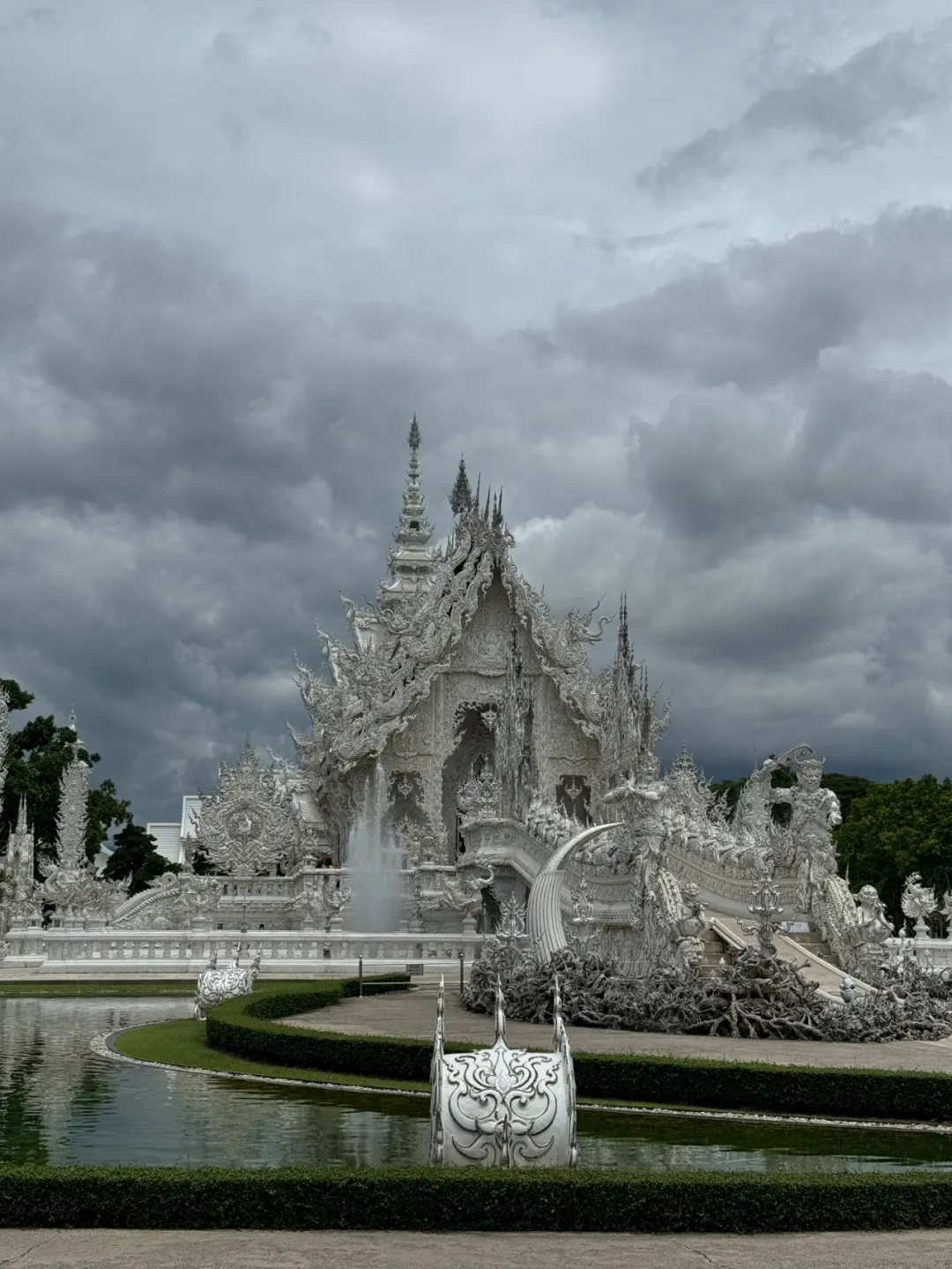 white temple
At first I assumed that the White Temple, like many temples in Chiang Mai, must have been built centuries ago. But that assumption was wrong.
While researching during the drive, I discovered that the White Temple was actually built in 1998 by Thai artist Chalermchai Kositpipat, who both designed and funded the project himself. The temple is still under construction today and is expected to be completed around 2070.
Before visiting, I had only casually seen photos of the temple’s outer areas. But once I saw it in person, I could immediately understand why people describe it as stylish.
It combines the architectural framework of traditional temples with modern elements, while blending multiple cultural and artistic influences together.
Several details particularly stood out to me:
-
The “hell” imagery at the entrance to the main hall, where visitors cross a bridge symbolizing the journey of rebirth from which there is no turning back.
-
The black and white floor tiles forming a Yin–Yang pattern, reflecting Chinese Taoist philosophy, while the decorative motifs themselves are distinctly Thai.
 It incorporates the Yin and Yang elements of Taoism
-
The artificial rock formations reminded me of the Water Curtain Cave from the legend of the Monkey King, and some of the rocks even resembled the shape of the Chinese character for “ghost.”
-
In the pond near the rock formations, there were small elephant sculptures with fish tails. The fish tail remained in the water while the elephant’s body rose above the surface in a dynamic leap. I imagine this symbolizes the idea of a carp leaping over the Dragon Gate.
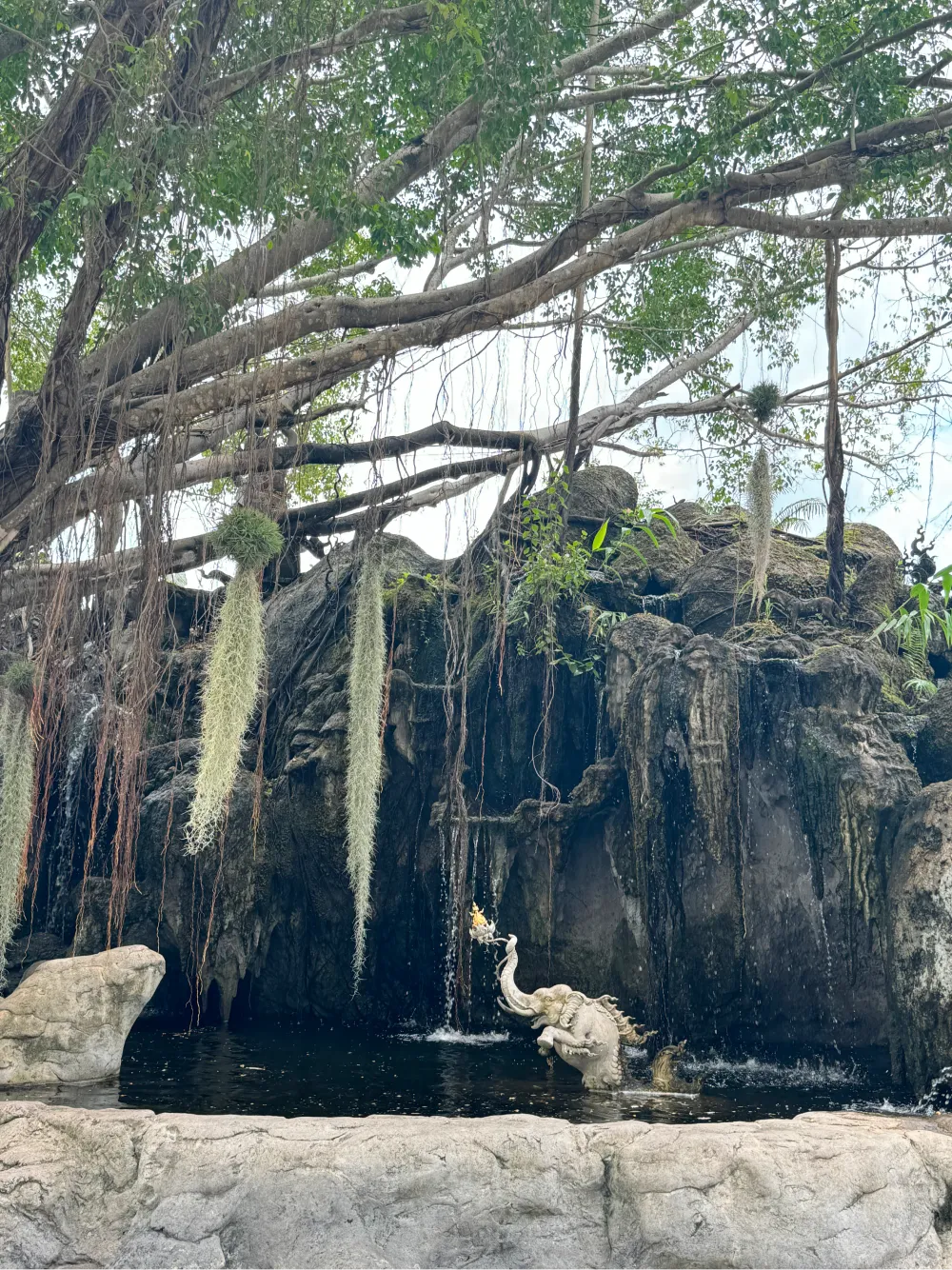 Strange Rock Fountain
-
Between the temple and the road runs a small river, where a strange statue resembling demons and mythical beasts stands. Its color scheme strongly resembles the palette often generated by modern AI art tools. Combined with the statue’s surreal shape, it almost looks like a cyberpunk version of hell.
-
And many more examples.
As mentioned earlier, we didn’t have enough time to explore the entire temple complex. But even from the parts we saw, it was clear that many Chinese cultural elements were present.
Only then did I realize that the designer of the White Temple is Thai-Chinese. Considering that the temple was built only a little over twenty years ago—and is still under construction today—it makes sense that it continues to absorb new influences.
The result is a strange but fascinating cultural mixture. Traditions, religions, and artistic styles quietly overlap here. There are undoubtedly many connections and artistic ideas that I still failed to notice.
Blue Temple: The Cyberpunk Blue of Alienation
It is said that the designer of the Blue Temple was once a student of the White Temple’s creator. Therefore, its design philosophy also revolves around emphasizing a single dominant color.
Among the three places we visited, the Blue Temple was the one that impressed me the least in terms of shock or novelty.
Compared with the White Temple, the Blue Temple appeared less refined. The craftsmanship felt somewhat rougher, and the complex itself was smaller in scale. I suspect financial resources may have something to do with that difference.
The most striking part of the Blue Temple is the enormous statues guarding its entrances. Anyone with megalophobia might feel slightly uneasy standing before them.
 Blue temple
Interestingly, on that day I happened to be wearing an entirely blue outfit, which matched the temple’s color palette perfectly—layers of dazzling blues everywhere.
The Blue Temple is also still under construction. When we entered, another statue was currently being built. I suspect many of these sculptures are funded by wealthy donors, because I noticed that one of them had a specific person’s name engraved on it.
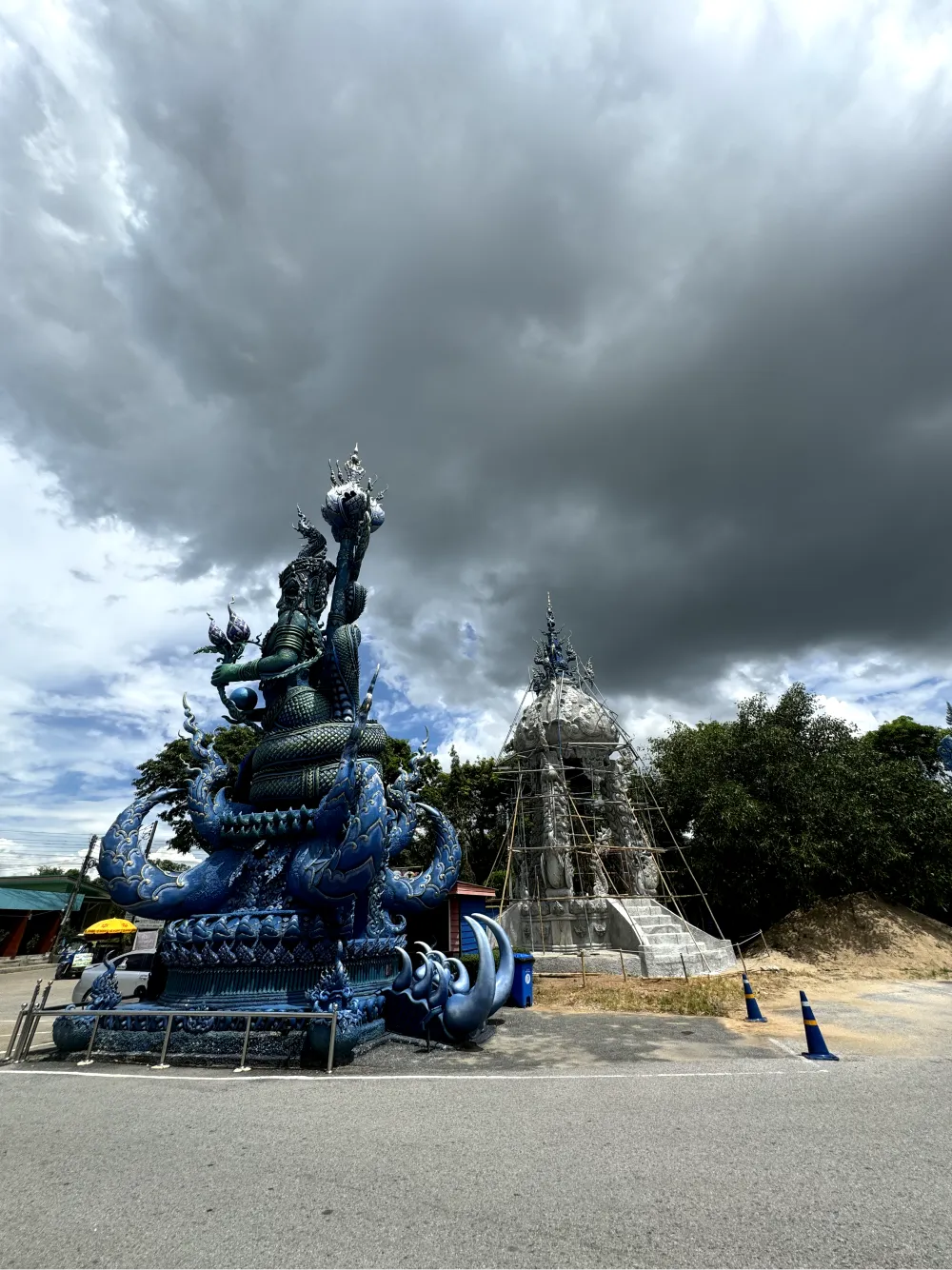 Blue temple
To be honest, among the three places, the Blue Temple gave me the most superficial impression of “life and death". Its symbolism felt direct, almost unavoidable. Perhaps this is because its artistic approach emphasizes sheer scale.
The four massive statues at the entrances loudly declare the presence of gods and hell in an almost unavoidable way. Their symbolism is extremely direct.
Another reason might be that I personally still struggle to fully accept heavily “alienated” artistic forms. The deep blue color—especially on the gigantic statues—gave me a slightly demonic feeling. The overall aesthetic felt strange and otherworldly.
Yet this eerie quality made me feel that the Blue Temple carries the most cyberpunk spirit of the three places.
On one hand, the roughness I mentioned earlier can be interpreted as a kind of populist rebellion, something less polished and more defiant—similar to punk or hippie culture, which stands apart from the refined elegance of the elite.
On the other hand, the color palette feels very similar to the visual style often generated by modern AI image tools. Much like the demon statue in the river at the White Temple, its colors seem to resonate with contemporary digital aesthetics.
Black House: Green and Black — An Altar of Animal Sacrifice
The Black House had the strongest impact on me out of the three places. In fact, it was the main reason I felt compelled to write this article.
When we arrived and were about to step out of the car, it suddenly began to rain.
Perhaps it was the rain that did it—but the thin misty veil it created made the already mysterious atmosphere feel even more enigmatic.
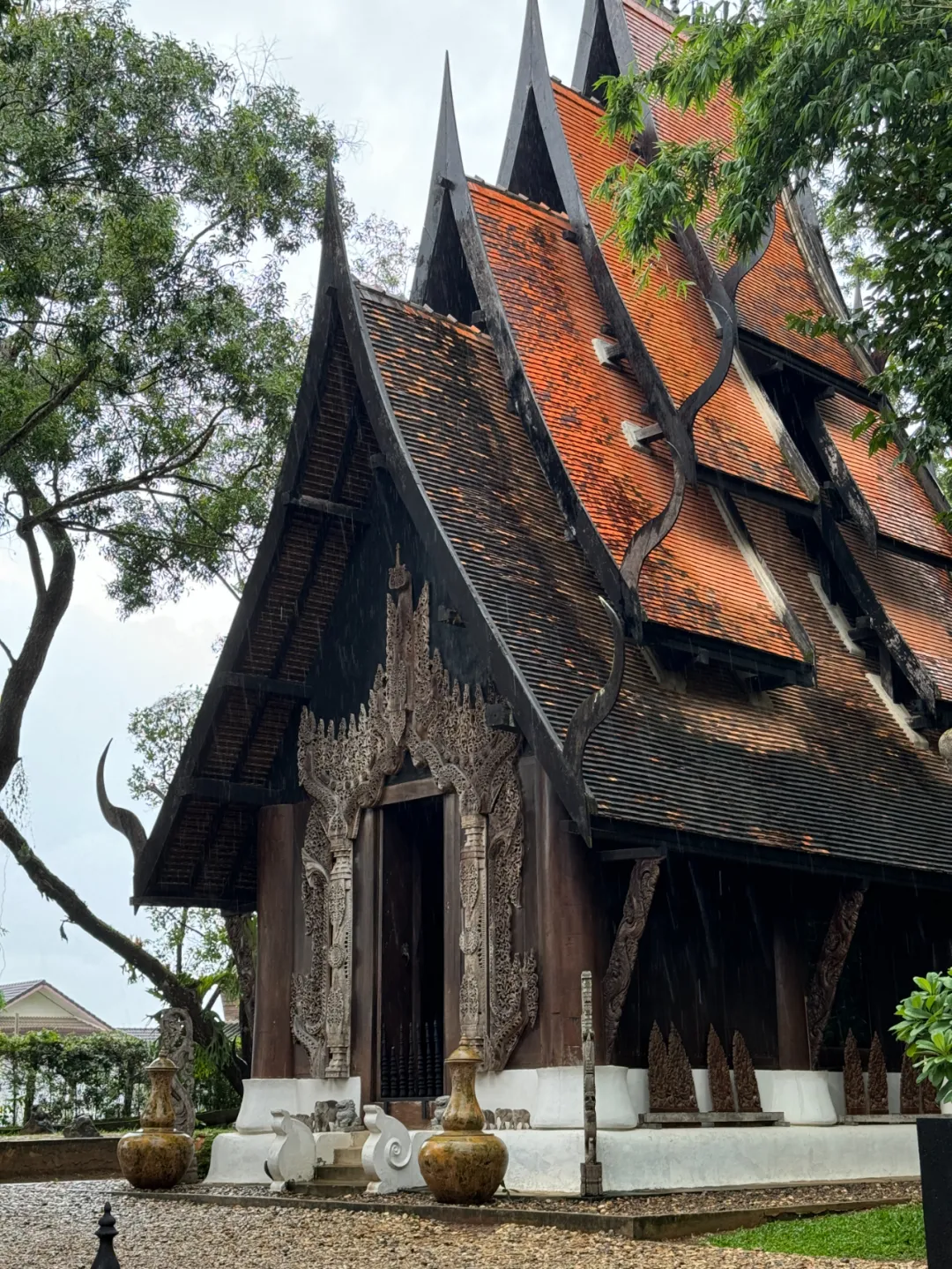 Black House Museum
Although some people group the Black House together with the White Temple and Blue Temple as “temples”, I personally prefer to simply call it the Black House.
Architecturally, it follows traditional Thai style. The site consists of a cluster of buildings: the largest is the exhibition hall, surrounded by many smaller structures of different types. All of them are painted black.
In the past, I thought red and black was the most striking color combination: passionate red and the deepest black. Blood-red eventually darkens into black—an ending of decay and death, while the process itself remains intense and vibrant.
But at the Black House, I experienced for the first time the collision between green and black.
The black wooden buildings, built in traditional Thai style, looked almost like coffins. And surrounding them was an overwhelming sea of green. Towering trees, emerald lakes, fresh grass — everywhere life was bursting with color. Yet inside the buildings, death was carefully preserved and displayed.
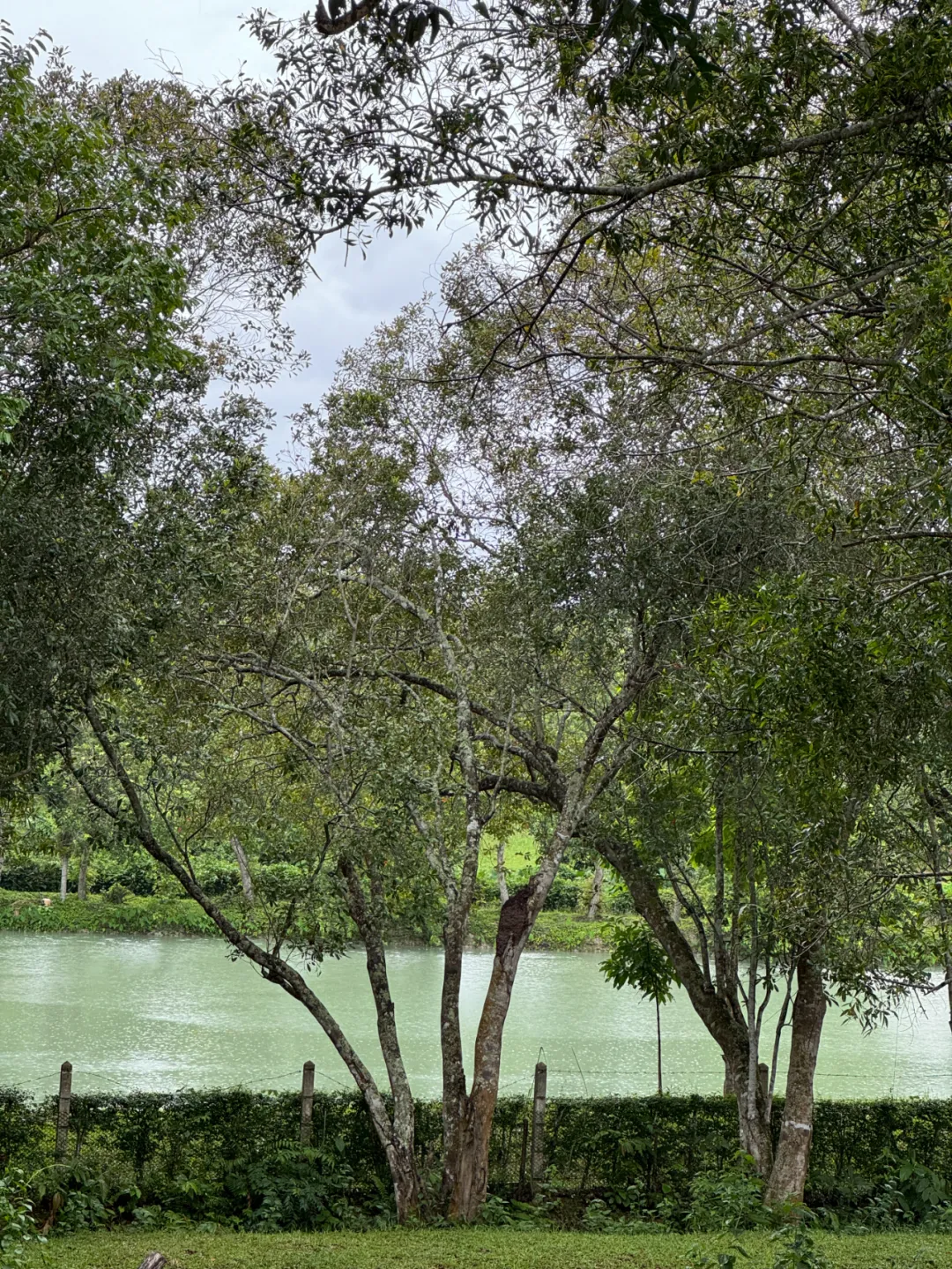
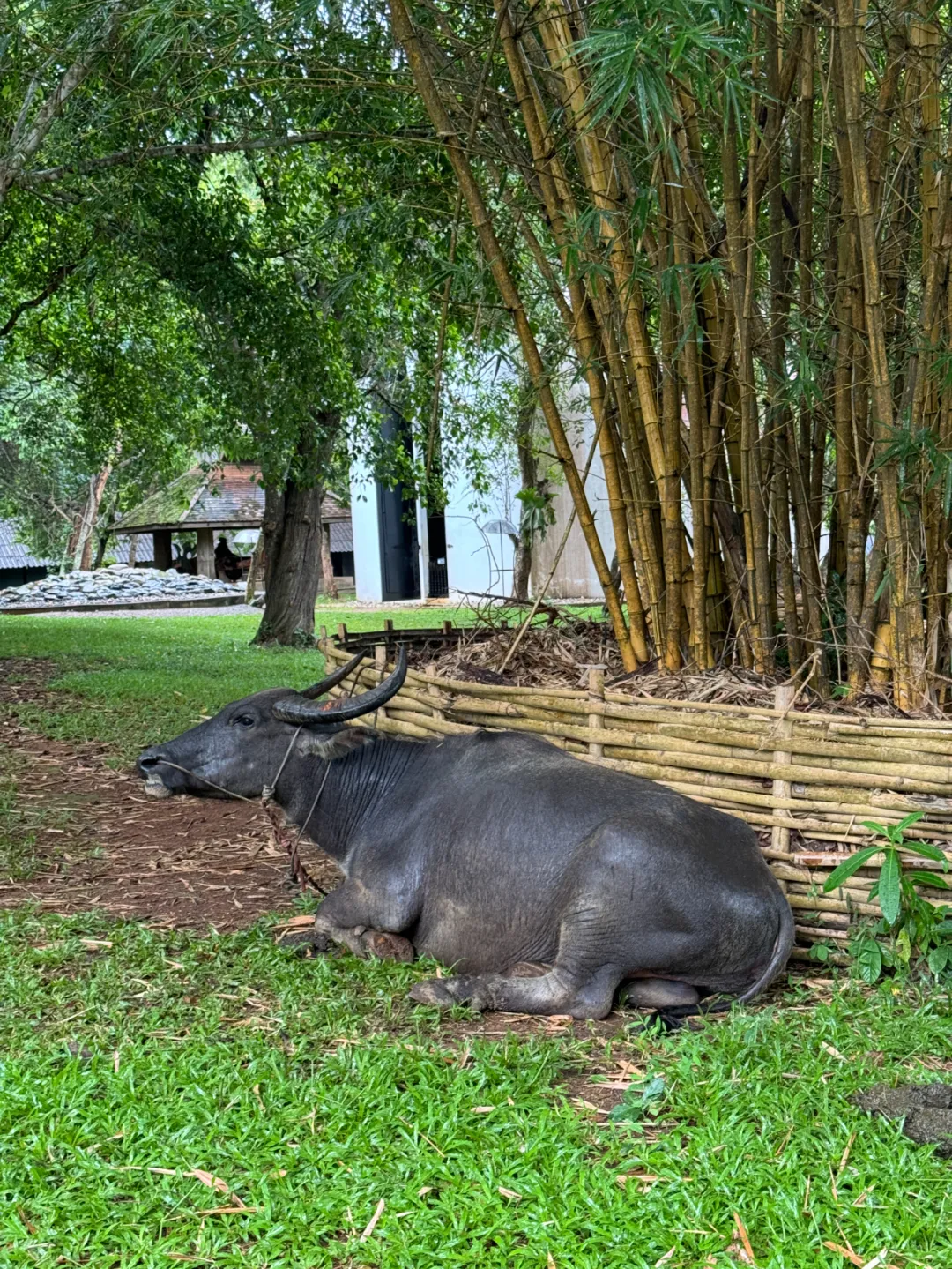
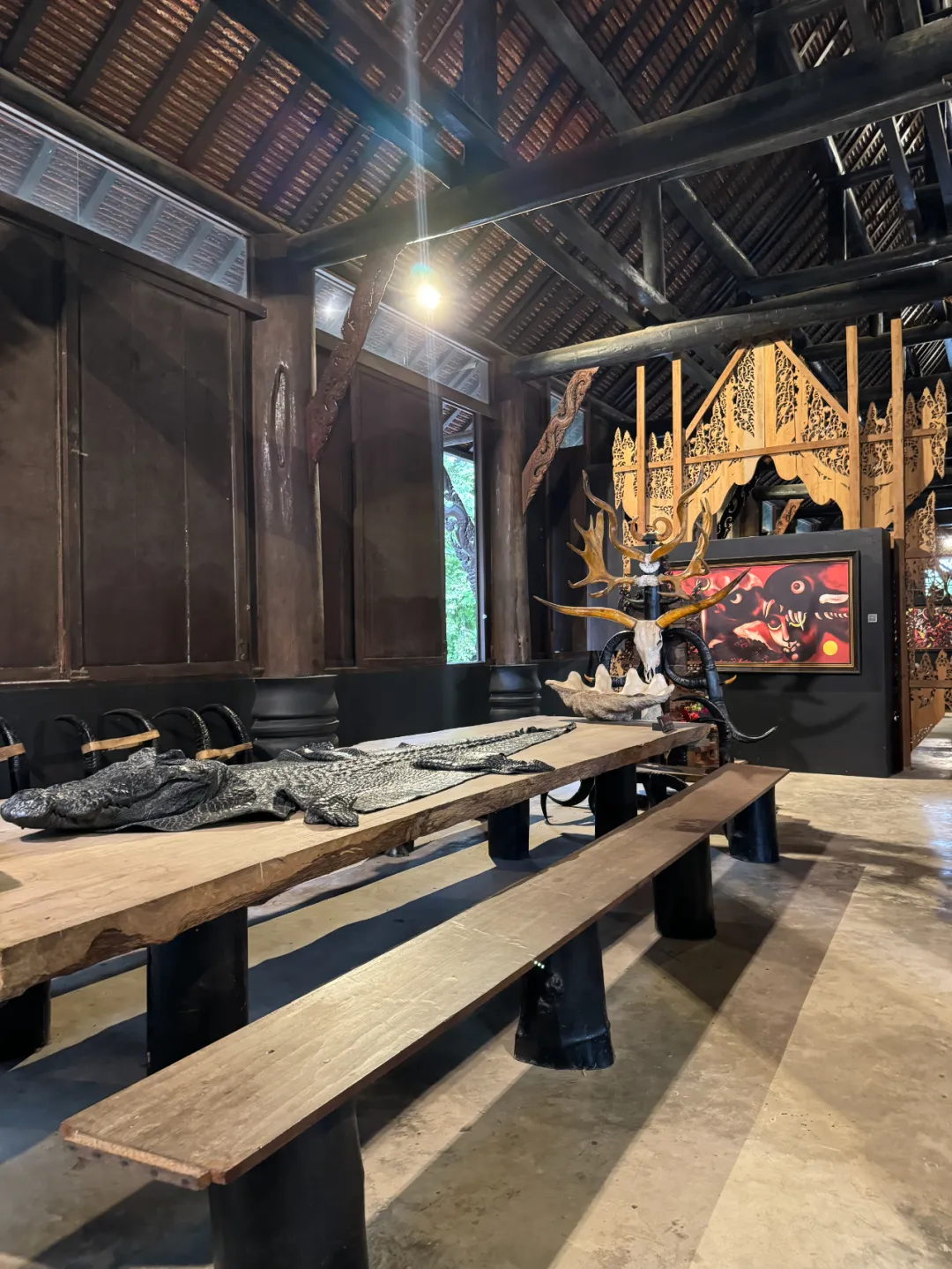
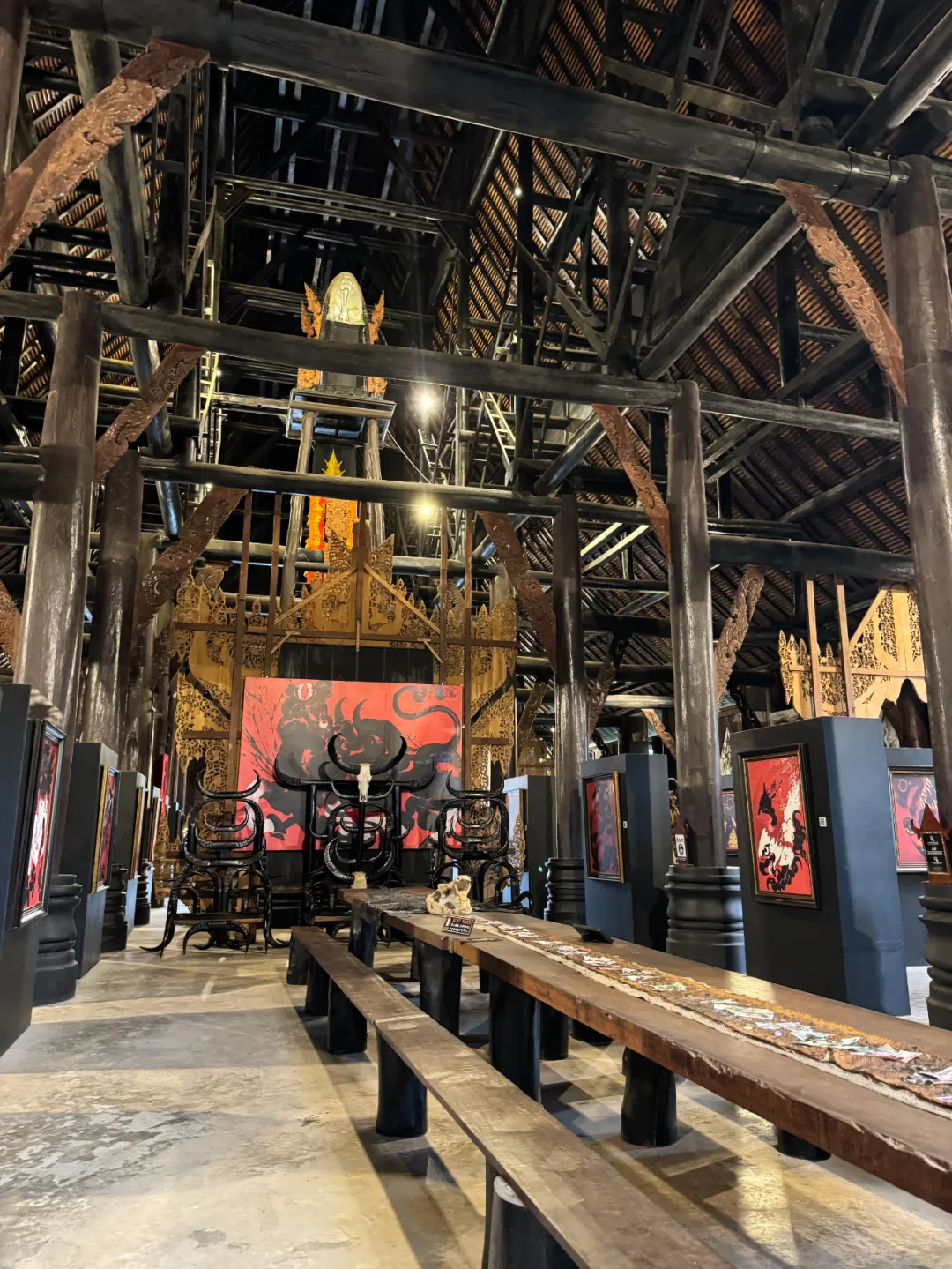
Throughout the Black House complex, there are many remains of animals. The most common are cow horns. I don’t know what species they originally came from, nor whether they are real or replicas, but I strongly suspect most of them are real.
They have been assembled into various forms—chairs, towering ladders, and other strange constructions.
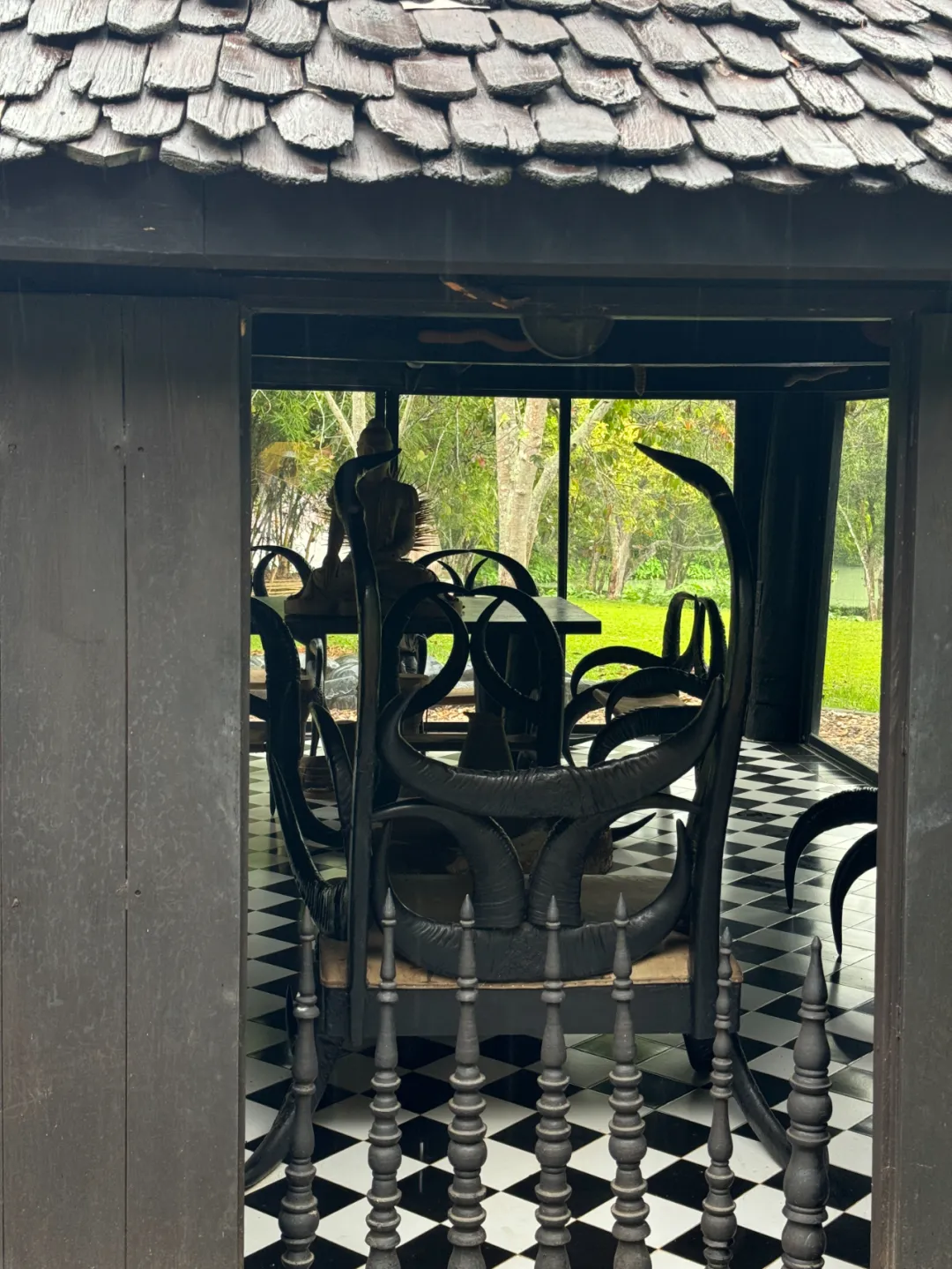
Besides the abundance of horns, several things initially shocked me:
-
Dried animal skulls hanging on the walls of the exhibition hall.
-
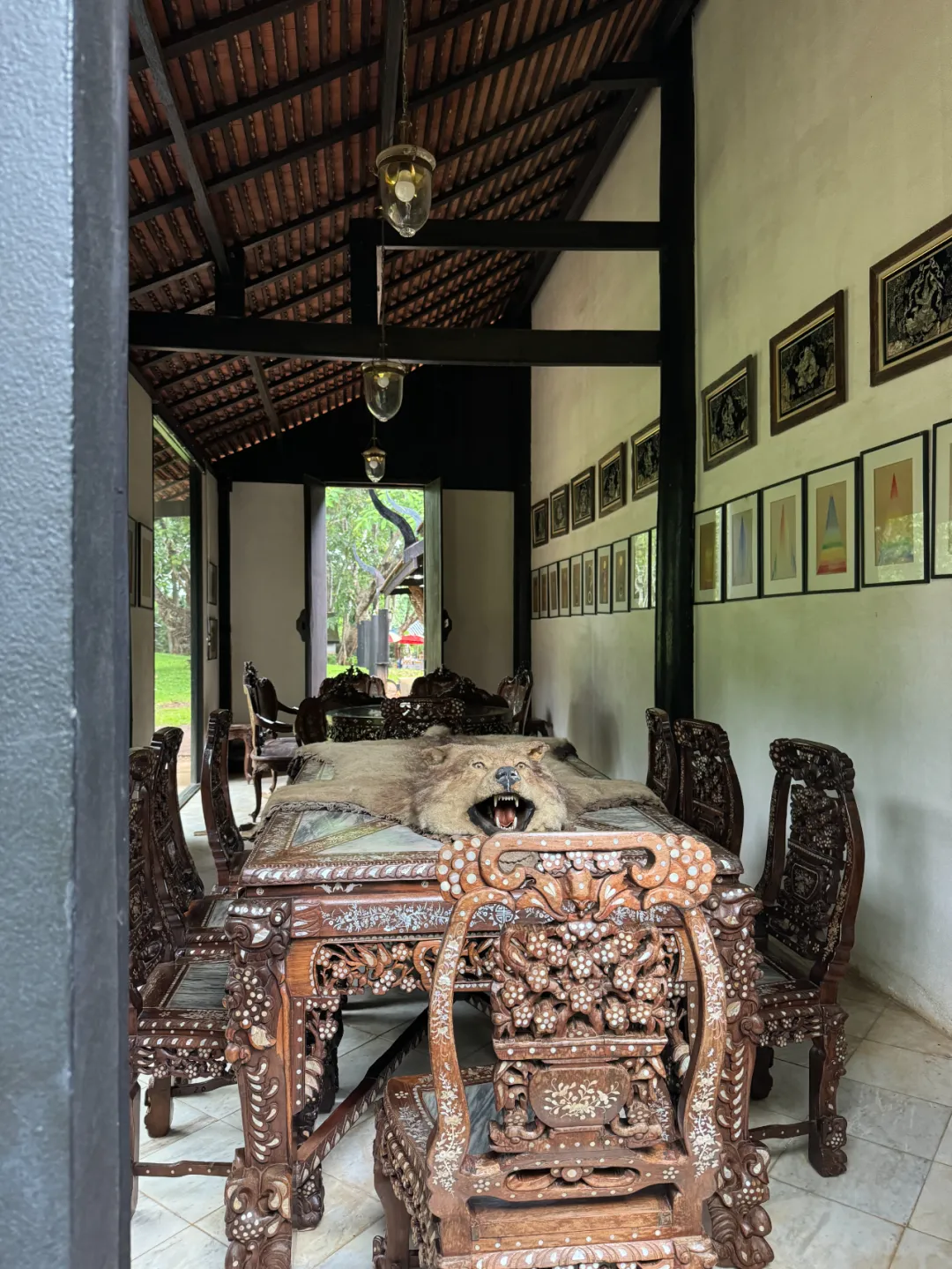
Preserved heads and skins of wolves, giant crocodiles, and pythons placed on tables.
-
Paintings depicting animals in violent, bloodthirsty scenes.
-
And later I learned that the ashes of the Black House’s creator are also displayed in the exhibition hall.
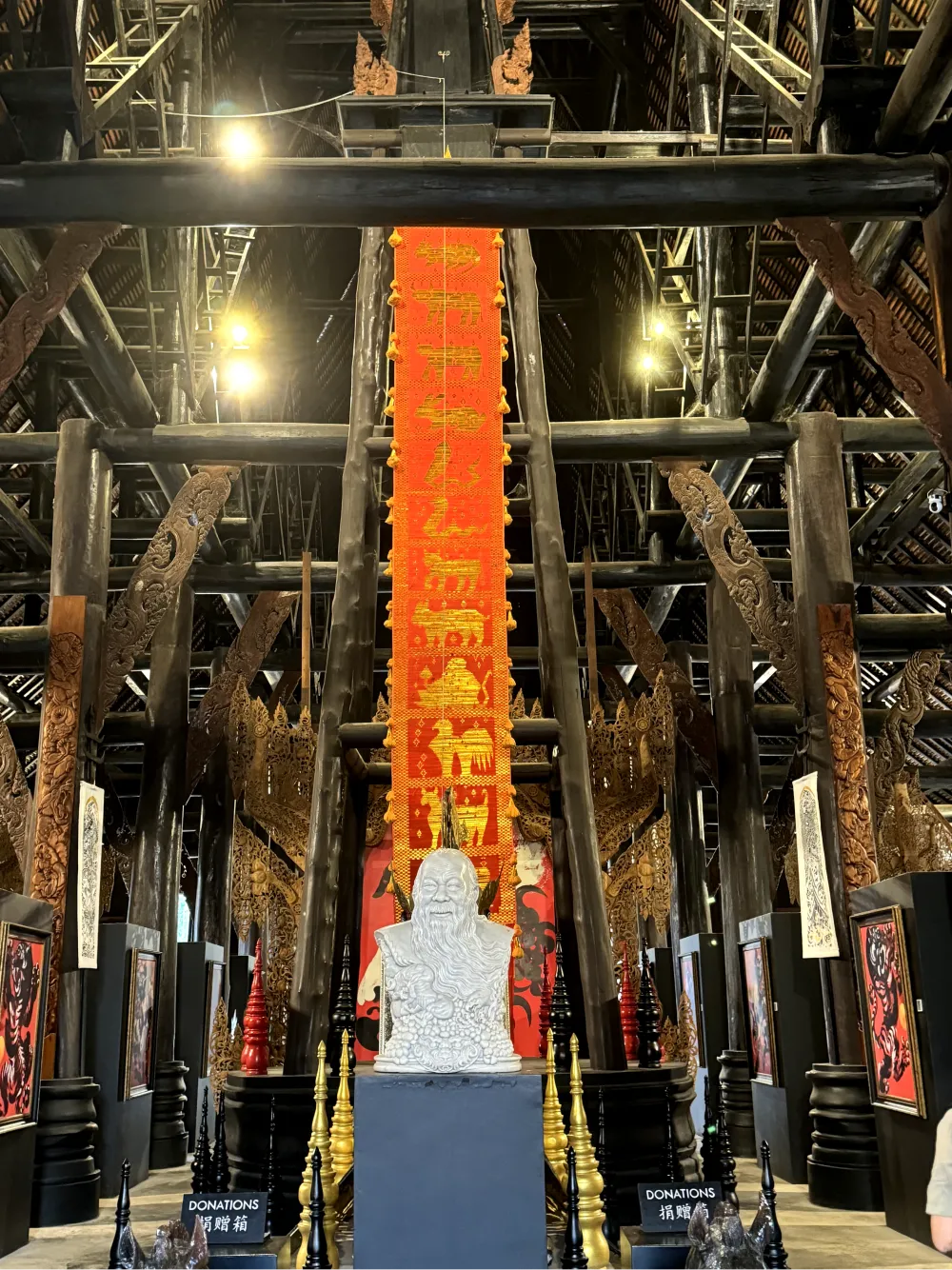
After seeing everything, I said to my friend:
This feels like an altar of animal sacrifice.
Elephants kneeling in submission, animal heads and skins displayed on human dining tables—perhaps their bodies have already been consumed, leaving only skulls and hides.
When these images are placed alongside the realities of domination, exploitation, and humanity’s relationship with nature, it becomes difficult not to reflect. The feeling grows heavy almost unconsciously.
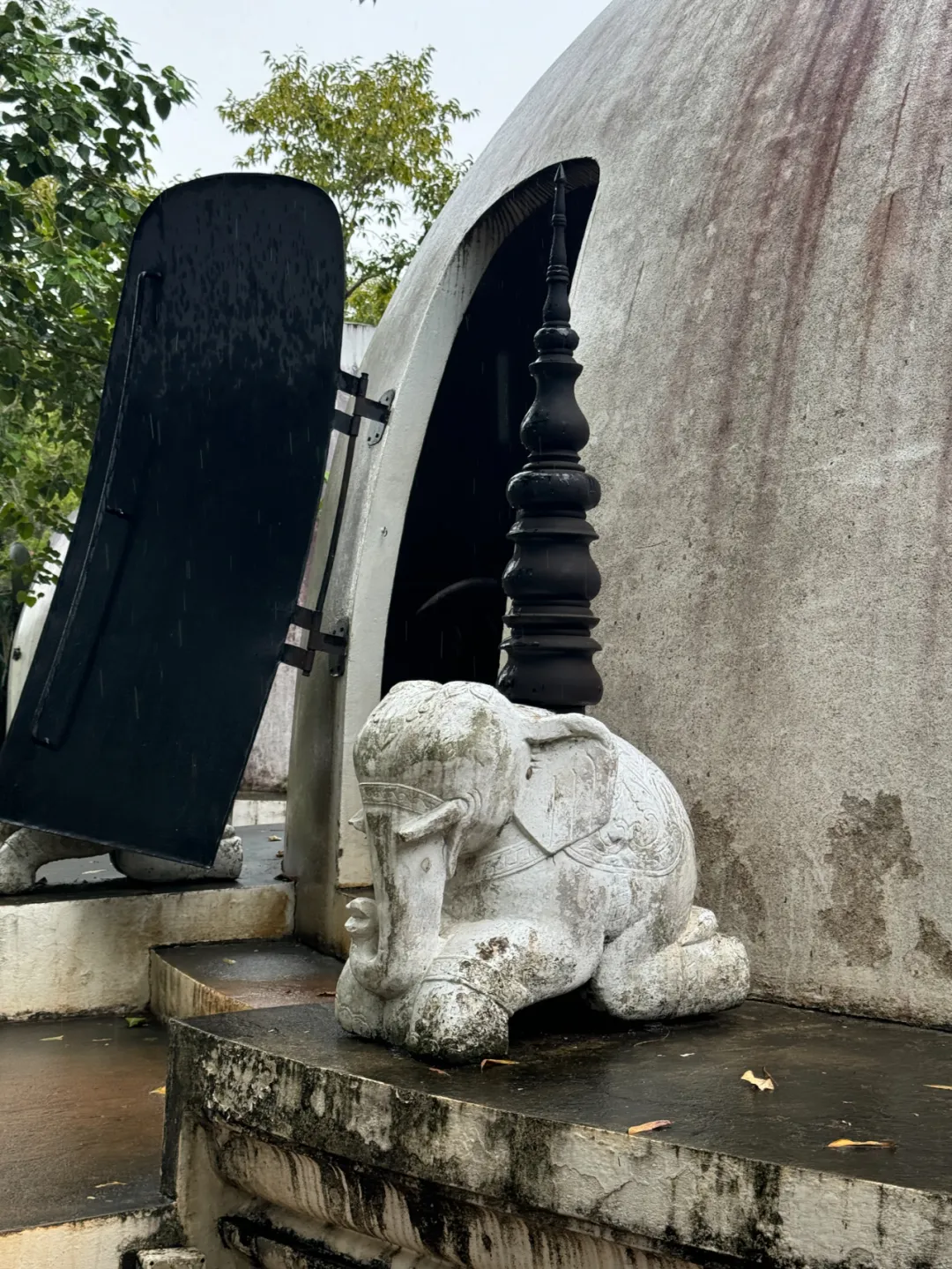
As for the sculptures and exhibits related to fertility worship, those are actually quite common in many museums. The Black House does have some, but not an overwhelming amount, so they didn’t shock me as much.
However, they did offer something to think about.
In this museum, the symbols representing male sexuality are extremely exaggerated: one sculpture depicts a wild man with an enormous phallus, while another shows a woman lying on top of a gigantic one.
I’ve seen many exhibits related to fertility worship before, and many of them emphasize maternal power. But the creator of the Black House clearly seemed more focused on male reproductive power.
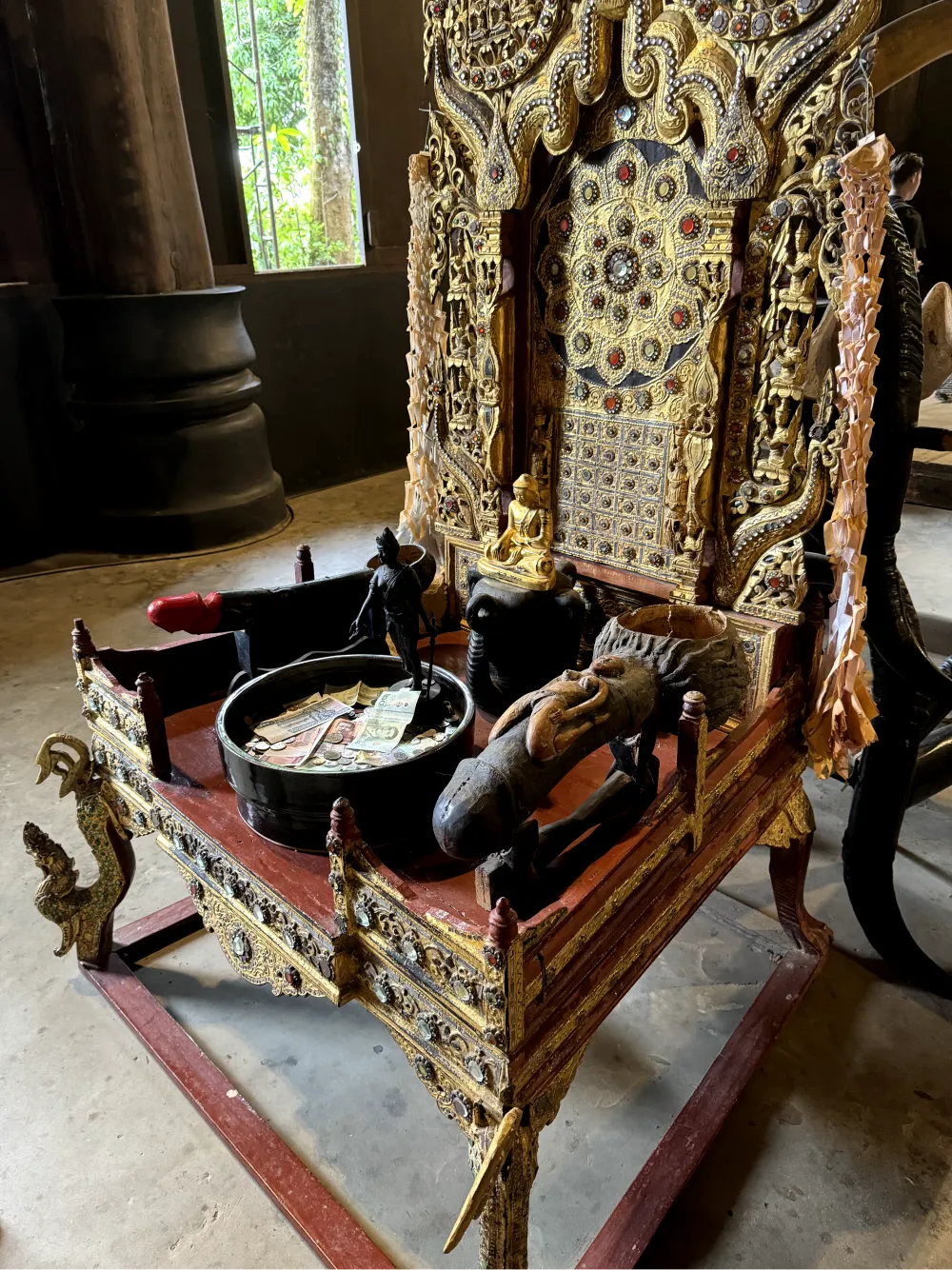
To summarize, the Black House left a profound impression on me. It made me experience the collision between green and black in a powerful and somewhat frightening way.
Yet fundamentally, it is still a museum. Its installations are deliberately curated, so the creator’s intentions and biases inevitably shape what we see. I accept that, though I don’t entirely like it.
Still, I would recommend visiting it. Especially in the rain. The quiet atmosphere and sparse crowds add an extra layer of eerie tension, making it easy to scare yourself.
There are also several stone formations where cow horns are arranged into structures resembling ladders to the sky, evoking ancient sacrificial altars.
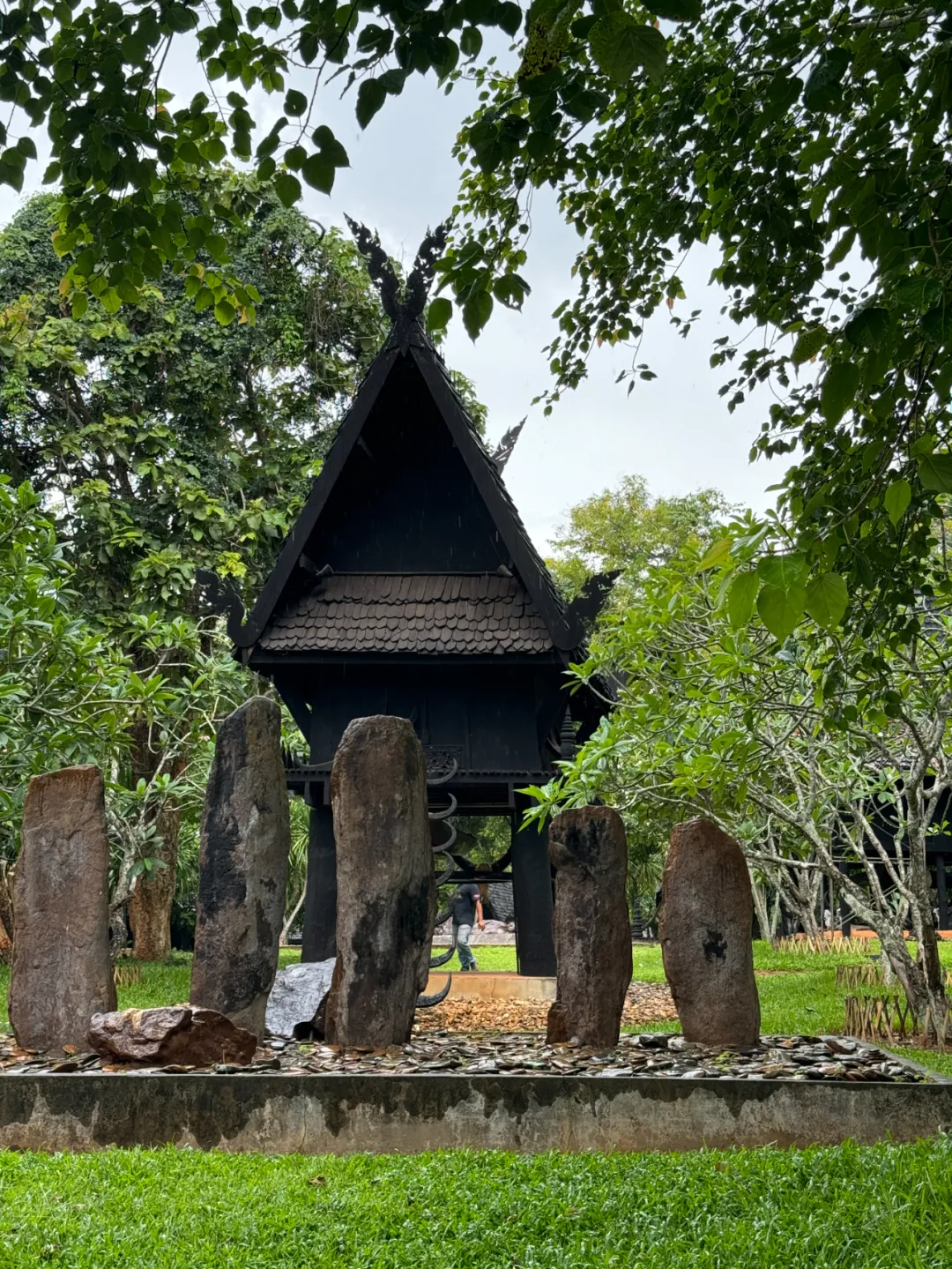
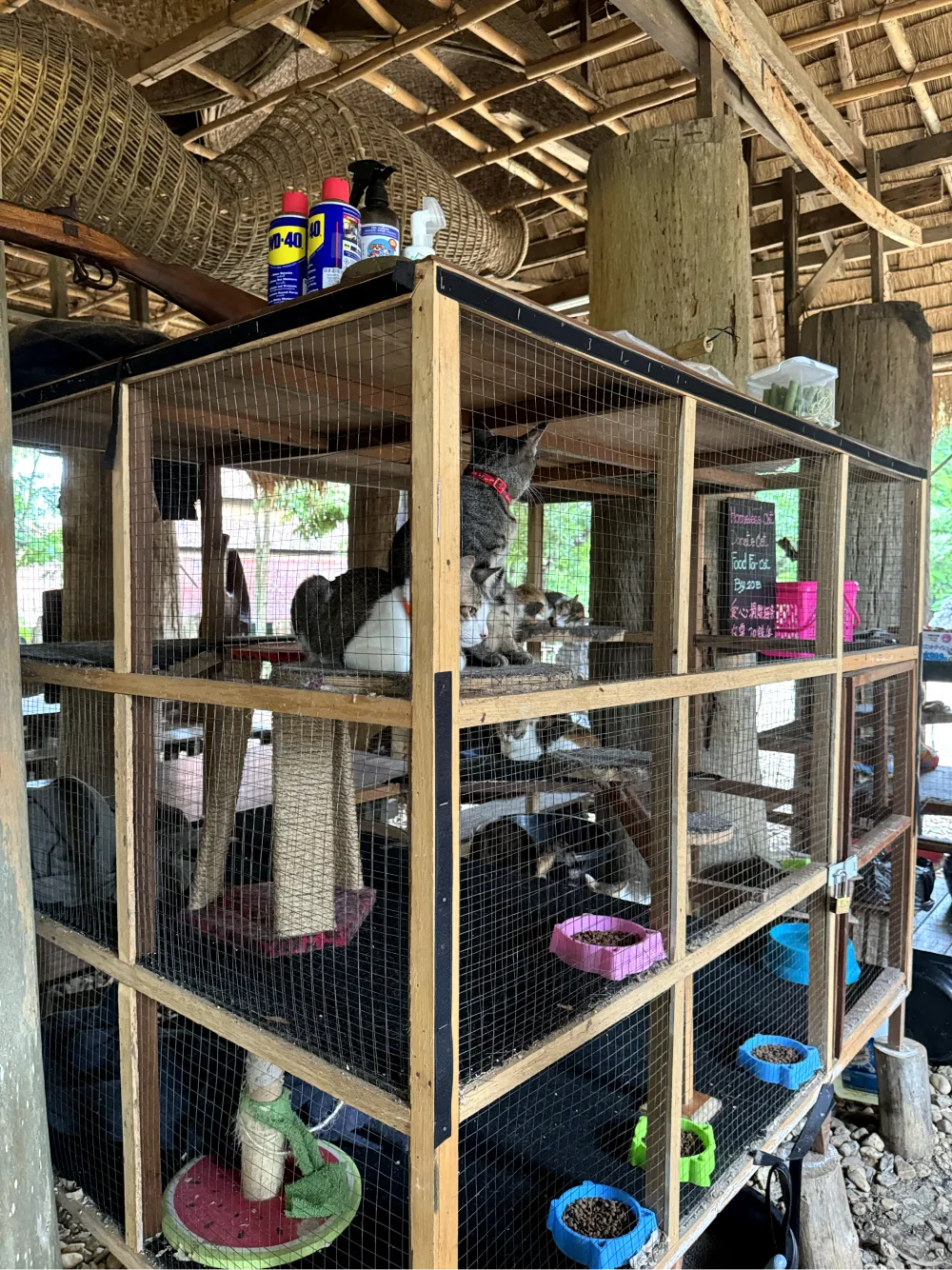
Another interesting detail: inside the Black House there is a small station dedicated to donations for stray cats. I’ve actually noticed many similar initiatives throughout Thailand. For example, when I buy coffee at the language school, I often see information about shelters for stray cats and dogs.